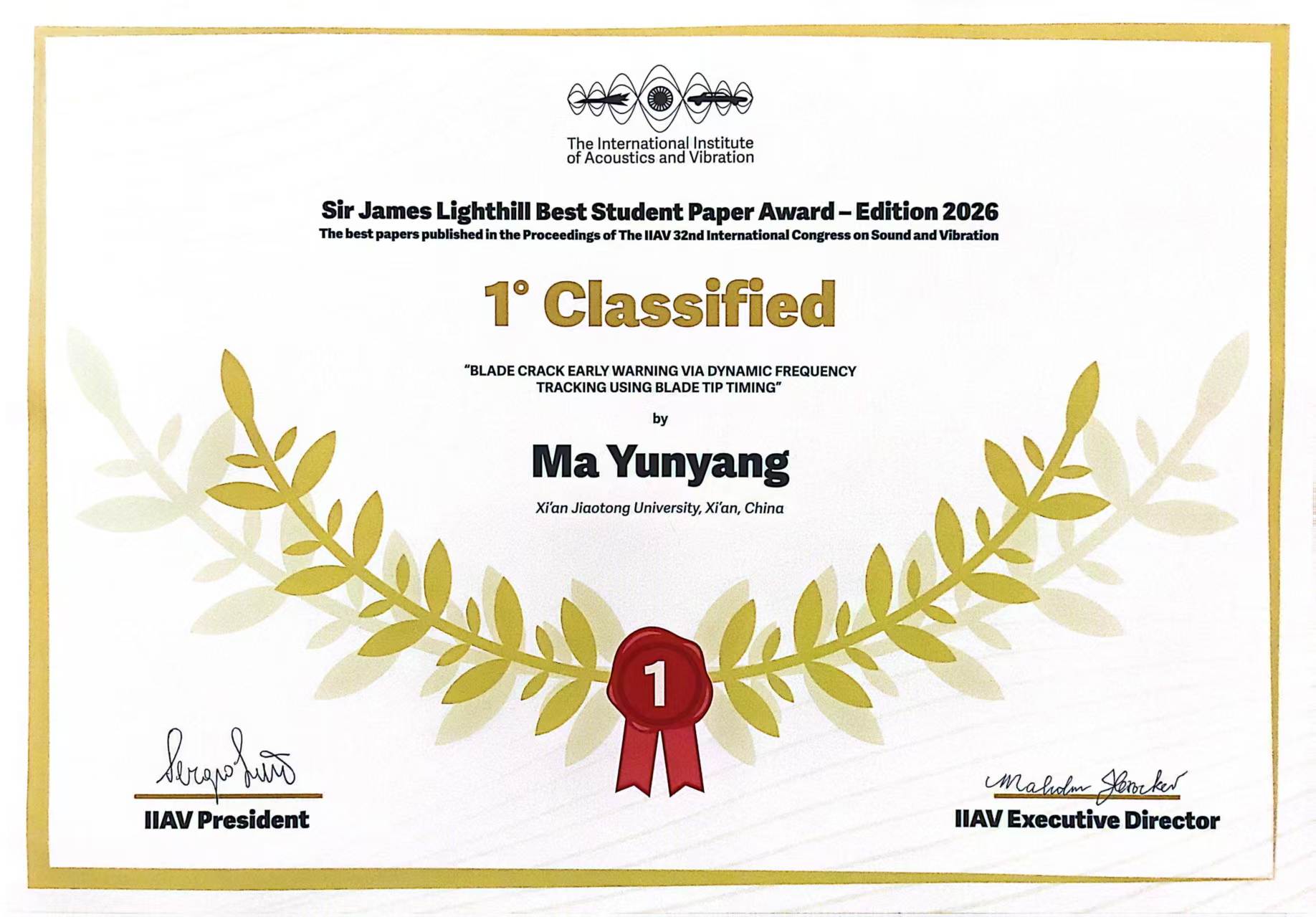
From July 5 to 10, 2026, the 32nd International Congress on Sound and Vibration (ICSV32) was held in Istanbul, Türkiye. Ma Yunyang, a 2024 Ph.D. student from School of Mechanical Engineering, won the First Prize in the Best Student Paper Award for his paper titled "Blade Crack Early Warning via Dynamic Frequency Tracking Using Blade Tip Timing." The work was supervised by Professors Qiao Baijie and Chen Xuefeng. The award was presented on-site by Professor Malcolm Crocker, Executive Director of the International Institute of Acoustics and Vibration (IIAV).

The Sir James Lighthill Best Student Paper Award, established by the IIAV, recognizes outstanding papers authored by students and early-career researchers presented at the ICSV conference series. This year, the award committee selected one First Prize, two Second Prizes, and two Third Prizes, based on criteria including scientific quality, originality, contribution to the advancement of scientific knowledge, and industrial application potential.
The International Congress on Sound and Vibration (ICSV) is a premier series of international conferences organized by the IIAV, bringing together experts from academia, research institutions, and industry worldwide to exchange the latest findings and explore cutting-edge methodologies and engineering applications. The congress attracted numerous research teams from leading universities, including Xi'an Jiaotong University, Shanghai Jiao Tong University, Beihang University, and The Hong Kong University of Science and Technology. The technical scope spans acoustics, vibration, noise control, signal processing, fault diagnosis, structural dynamics, and structural health monitoring, reflecting the congress's broad influence in the international acoustics and vibration community.
The award-winning paper addresses the critical need for vibration monitoring and early crack detection in aero-engine rotor blades. To overcome challenges such as non-uniform undersampling, strong noise interference, and the difficulty of continuously and accurately identifying dynamic frequencies in blade tip timing (BTT) signals, the authors propose a novel time–frequency reconstruction method based on multi-probe BTT measurements. By processing consecutive measurement signals in batches, the method exploits the structured sparsity of BTT signals in the time–frequency domain and leverages joint sparsity among adjacent measurement vectors, thereby significantly improving the accuracy and noise robustness of dynamic frequency tracking. This research offers a promising solution for the early identification of blade crack faults.




 中文
中文
